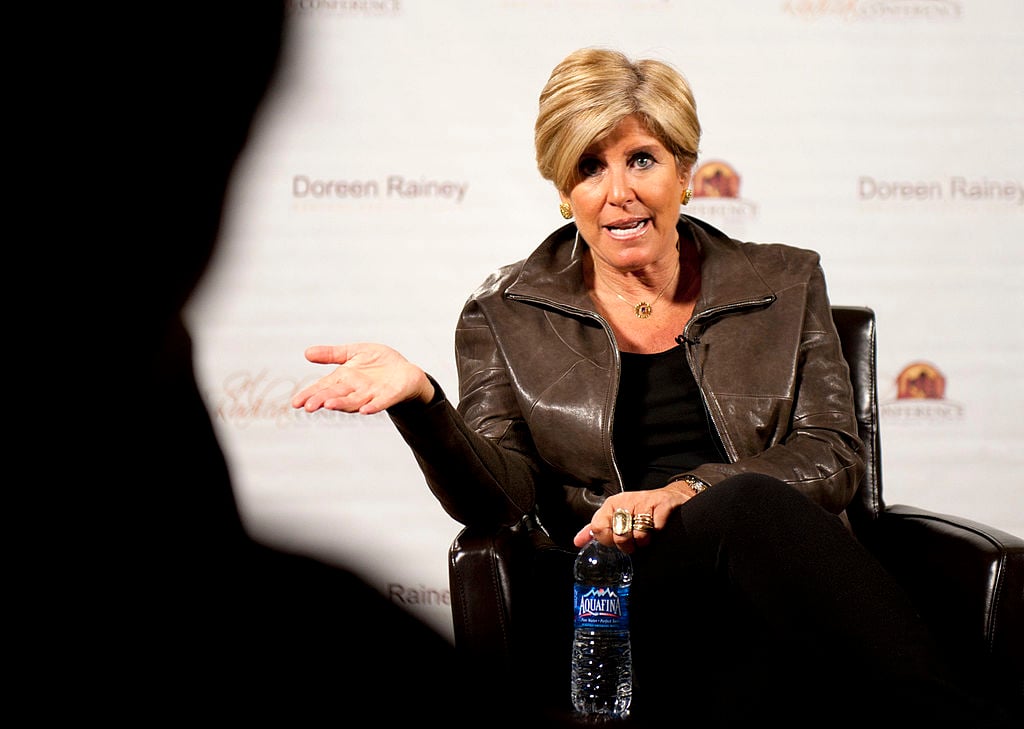
Conservative higher ed commentators and a former president of a national association of student affairs professionals harshly criticized the association’s public apology last week for a speech by financial expert and television host Suze Orman as being emblematic of the “cancel culture” prevalent on college campuses and growing attempts by certain groups to stifle free speech.
The apology by leaders of NASPA: Student Affairs Administrators in Higher Education characterized Orman's keynote address last Wednesday at the association's virtual annual conference as “insulting and insensitive,” among other things. The mea culpa was issued after many attendees panned the speech on social media and blasted Orman for being uninformed and for insufficiently contextualizing her speech with current socioeconomic realities. Orman referred to the South Side of Chicago, where she grew up, as “the hood” and “the ghetto” in her comments. Her critics said, and the apology statement reiterated, that Orman overlooked systemic racial, class and gender barriers to wealth that many student affairs professionals face and instead “tied self-worth to financial progress.”
The address prompted a barrage of critical tweets in real time from some NASPA members as they watched the event. They said Orman was deeply out of touch with her audience and higher education issues in general. A few hours later, NASPA president Kevin Kruger, board chair Angela Batista and conference chair Michele Murray emailed and posted an apology that said the association had “missed the mark.”
Robert Correnti, a former president of NASPA from 1984 to 1985, said in a letter to the NASPA leaders, which he shared with Inside Higher Ed, that he was “embarrassed and ashamed” by the apology, which he called an “inappropriate” overstep. He said the leaders' action set a bad example for student affairs professionals that speech including comments that some individuals find offensive should be negated in its entirety. Correnti believes the harsh criticisms of the speech and the apology are examples of the “cancel culture” trend in higher education that punishes speakers, or prevents them from speaking in the first place, because some people on campus disagree with their views.
“In this instance, I think you not only did a disservice to NASPA, but to the entire profession as well,” wrote Correnti, former vice president of student affairs and vice provost of enrollment management at Florida International University.
“You as leaders should be wise enough and courageous enough to push back on all those ‘offended’ in the interest of free speech and open dialogue,” he wrote. “Higher education institutions and associations give students and professionals the opportunity to be exposed to a variety of issues and opinions, unless we start censoring.”
Correnti, who retired from FIU in 2002, said in an interview that he is concerned the association’s response to the keynote set a disturbing precedent for student affairs professionals who frequently deal with free speech controversies over speakers on their own campuses. He recalled facilitating a speech on FIU's campus by Khalid Muhammad, the late leader of the New Black Panther Party, who held anti-Semitic views and was invited to speak by the Black Student Association. He noted that he made sure the speech took place despite opposition to Muhammad by other students.
“I believe the leadership of NASPA should be providing the role modeling,” Correnti said. “In this instance, they have done just the opposite.”
Niki Messmore, a student affairs staff member at Indiana University’s School of Medicine, says NASPA’s apology has nothing to do with how staff members respond to free speech debates on their campuses. Messmore, program director of community and civic engagement for the school, said in an email that the “conservatives who are upset about NASPA’s apology need to open up a constitutional law book.”
“This isn’t a case of free speech, but selecting the right person for the job,” she said. “At the end of the day, NASPA chose a speaker who was fundamentally ill equipped to address financial barriers for student affairs professionals. There is no correlation between selecting a keynote speaker at a professional conference and how one supports democratic discourse on their campus.”
Messmore said conservatives, such as American Enterprise Institute scholar Frederick Hess, who wrote a critique about the incident in Forbes, are weaponizing the incident rather than discussing the issue at hand.
Hess, director of education policy studies at the conservative think tank in Washington, D.C., said NASPA should have simply stated its disagreement with Orman's speech, rather than issuing a “tortured, pandering apology” for her comments.
Hess said he found it “remarkable” that some conference attendees were offended by Orman’s comments about bettering their financial circumstances and practicing personal financial responsibility -- advice for which she is known for consistently giving. Association leaders should have been aware of and prepared for what she might say when they booked her as a speaker, he said.
“If the majority of the organization was pounding desks and sending emails and tweets, asking the organization to apologize, then that’s terrifying to me,” Hess said. “If it was just a couple dozen, 50 or 100 people creating a fuss and the organization felt obliged to cave, that’s terrifying to me.”
Frank Lamas, who served as a board chair for NASPA for six years and recently retired as vice president of student affairs and enrollment management at Fresno State University, initially considered Orman a fine choice for the conference. He said student affairs officials -- including those at the last two institutions for which he worked -- have been increasingly opening offices that offer students money management guidance, and he thought staff members could benefit from the financial advice Orman tends to provide.
Lamas appreciated the association’s attempt to balance members’ wishes and beliefs.
“Trying to make everybody happy is not an easy thing to do, whether you’re running a conference or writing a program,” he said. “I thought she was a good choice for members, but obviously it didn’t turn out so well. I do think it’s important for us to have well-balanced speakers or ideas and for people to make their own judgments.”
Kruger, the NASPA president, defended the association's apology in a written statement to Inside Higher Ed.
“In representing student affairs professionals from across the country, we have a responsibility to present material that meets the current moment and the challenges our members face on their campuses,” the statement said. “We heard our members when they said this particular presentation was offensive and moved to address those concerns.”
He did not address questions about the process for booking Orman or whether she was prepped for an audience of higher ed professionals. He also did not address repeated calls to release a recording of the keynote address; he said last week that the association would not make it publicly available.
Separately, Kruger debunked claims that Orman was paid thousands of dollars to speak at the conference, which some observers falsely stated on Twitter. He said Orman was not paid for the speech. Orman’s representatives did not respond to requests for comment submitted through her website.
For her part, Crystal Lay, director of residence life for the University of Colorado, Boulder, thought NASPA's apology was appropriate. She attended the conference and watched the full address, and said that as a Black woman from Chicago, she could not “think about money and class without thinking of the intersection of race and also the acknowledgment of historical and systematic oppression.”
“I think it is important to call out problematic statements and behaviors especially when there has been a significant impact on a community -- the community that you serve and represent,” she said via email. “Some will try to say that this is cancel culture -- the apology -- but this is about accountability. This is about being responsible. It is so important to acknowledge the harm caused and then work to do better.”
 from Inside Higher Ed https://ift.tt/3sCpbuy
via IFTTT
Comments
Post a Comment